Friday, April 30, 2004

A Long and Heartbreaking List of Names


BY SUSAN AGER
FREE PRESS COLUMNIST

At 15, I curled on my bed to study the glossy pages of that Life magazine, filled with the faces of every American lost in one week in Vietnam.

Many of the 242 photos, 20 per page, were high school senior pictures. These dead weren't much older than my boyfriend.

My parents subscribed to Life, known then as America's favorite magazine. But in that week in June 1969, it smacked us all in the head with those faces. I looked into their eyes, and I thought simplistically, as children do: "This is so sad and so wrong."

Wrong because I couldn't put into sensible words why so many young soldiers had to vanish from the world or how the world would be better for the sacrifice of their heartbeats.

Half an hour of names

Tonight, "Nightline" anchor Ted Koppel will pose the same challenge to Americans with a half-hour recitation of the names of more than 530 men and women killed by hostile fire in Iraq.

Twenty were from Michigan.

As he reads, the screen will unroll their faces, ages and hometowns as a ribbon of whys.

Each of us must choose: to avoid the litany, to watch until we're bored or shattered, or to force ourselves to face all those eyes, imagine those lives and draw what conclusions we will.

Koppel's producer contends the show, without even background music, isn't meant to boost ratings. It isn't a political statement, he says, although conservative editor William Kristol slammed it as "a statement with a capital S, and . . . a stupid statement." Its timing falls smack at the end of the worst month of the war and fails, Kristol said, to name the dead from Afghanistan or those killed in 9/11's terrorism.

I'd add that it also neglects the Iraqi dead. Naming them would require a long series of "Nightlines."

Koppel's producers can't predict whether people will watch for 20 seconds or 20 minutes or not at all. But we know from experience that the reading of the names of the dead from any tragedy is compelling and hypnotic.

Continue reading article at Link


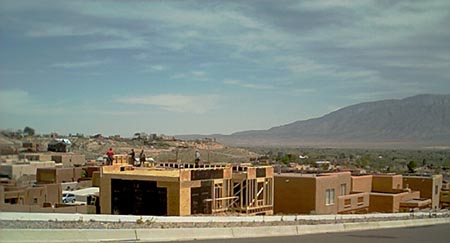
Urban renewal - Albuquerque style

Greenspan's Choice: Scylla or Charybdis?
by Nelson Hultberg

In Homer's famous epic, the Odyssey, its hero Ulysses must endure a long series of dangerous adventures in his journey home from the Trojan Wars. He and his men come under fire at every turn, as some new, death-threatening predicament is thrust upon them in their efforts to find their way back to their wives and families. The one-eyed monster Cyclops imprisons them in his cave, while the beautiful seductress Circe turns Ulysses' men into swine. The Sirens force Ulysses to tie himself to the ship's mast so as not to be lured to his death by their irresistible songs.


Only the blind cannot see Scylla and Charybdis looming up ahead -- waiting to consume us. As Richard Russell so sagely puts it, "What the Fed and the US government have done is to build the greatest edifice of debt ever seen by one country in history. And this debt continues to build. For the US government, the debt build-up is continuing at the rate of over $13 billion a WEEK. The current rising trend in interest rates will bear down on this ocean of debt. This pits the forces of deflation directly against the forces of inflation.

"This impending battle of inflation vs. deflation is going to be one of the most critical economic confrontations seen in decades. Frankly, I don't know how it's going to turn out -- and neither does anyone else. In fact, I'd say 99 percent of the US population is unaware that it's even happening." [Dow Theory Letters, April 13, 2004]

Obviously to those of us who are aware of the impending battle, knowing which of these two scenarios awaits us would be most advantageous. Will America explode into hyperinflation, or will she collapse into all-consuming deflation? If that could be known, then one could direct his investments accordingly and reap considerable profit in the markets. If only he knew for sure.

In the long run, collapse of some kind is coming. That is the unavoidable nature of a boom-bust Keynesian economy. But which will come first, Scylla or Charybdis?

Read entire article at Link

Thursday, April 29, 2004

My Feathered Friend

I've been asked to post this story again, since my writing website
Tales From The Land of Entrapment has been down for awhile....
This is a tale from our former home of twenty years. Apparently the
new owners moved in and started pissing off everyone, not realizing
they now live in a hornet's nest--a family of warring neighbors that goes
back hundreds of years. The neighbors are not happy that the newcomers
are dealing out some of their own medicine - bulldozing, cutting down
trees, replacing beauty with rocks and gravel, noise and traffic -
just like they did all those years!
So it is with some nostalgia and no regrets I present this...
Tale from the Land of Entrapment:


(This is also a post for May 1 - Sound and Place on the collaborative weblog/wiki
for Writing About Place, Ecotone Wiki)


My Feathered Friend

In the '60s we protested for peace--now?--we'll settle for some peace and quiet.

Our home in Corrales may seem peaceful, yet with the whizzing traffic up front at the road and the barnyard cacophony in back, it is hardly ever quiet. A houseguest emerged from his slumber one morning with a puzzled look on his face, asking, "Is there a zoo around here?" The cows' mysterious mooing is like a cross between a rusty gate hinge and an elephant mating call.

Our second-story bedroom opens out onto a deck facing west towards the irrigation ditch and the rising escarpment. You can hear everything at once from up there?those cows, horses, burros, goats, sheep, yowling tomcats and howling coyotes, literally. Bullfrogs and crickets throb through summer nights occasionally pierced by the eerie feline cries of peahens. Church bells bong on Sunday morning, while hot-air balloons hiss and drift over the field, accompanied by a chorus of barking dogs.

Mornings we awaken, depending on the season, to honking geese, raucous crows, chortly finches and sparrows squabbling; the strange and wonderful sandhill cranes cruising by; woodpeckers working at the eaves, or comedic roadrunners chattering, challenging a watchful cat.

Sometimes I lie semi-awake in bed listening for my favorite bird, so small I?ve never seen her, yet she returns each spring with her distinctive song?a long story with a question mark at the end. She arrives with a big voice by the time the apricot trees burst into blossom, alive with an industry of bees.

Other days are less pleasant--rude awakenings to the sounds of my neighbor?s recreational bulldozing, incessant beeping front-end loaders and backhoes scraping, chainsaws, road construction and heavy equipment hitting it hard at 6 a.m.

continue reading at myfeatheredfriend.html
Show Me The Jobs
By Judith Gorman, AlterNet

For the past several weeks, President Bush has been barnstorming the
country to tell us the good news - the nation's payrolls grew by
308,000 in the month of March, the largest one month jump in four
years. "People are finding jobs, and the nation's future is bright.
America's families and workers have reason to be optimistic."

So what are these "new jobs?" Well, 13,000 of them are California
grocery workers returning to work after an extended strike. Another
31,000 represent new government jobs. 71,000 "new jobs" are in the
construction industry, a seasonal upswing independent of the
President's policies. 11,000 "new jobs" are in credit intermediation,
reflecting the surge in home refinancing due to low interest rates.
And 36,000 "new jobs" are in health care or social assistance, jobs
created to help people who no longer have jobs.

What the President fails to mention is the bad news. As New Jersey
Senator Frank Lautenberg (D-NJ) remarked: "Only in the Bush 'economic
recovery' can our country gain jobs and increase the unemployment
rate in the same month."

......So where does President Bush's good news come from? Corporate profits
have risen 57.5% since the first quarter of 2001, while private wage
and salary income has fallen 1.7%. According to Business Week, the
average compensation for CEO's of large corporations in 2003 was $8.1
million, up 9.1% from the previous year. In the Bush lexicon, that's
called a "recovery."

Read more at link
showmethejobs.doc

Wednesday, April 28, 2004

Operation Iraqui Liberation -- O.I.L.

Here's another consideration, as we wipe away tears for the
human cost of war in Iraq. What about the economy, stupid?
War is good for the economy, isn't it?
Wrong.

War in Iraq Aims a Bullet at the Heart of the Economy
By James K. Galbraith
Los Angeles Times

There's no indication that Bush thought through the potential for far-reaching fiscal damage

The U.S. had one good economic experience with war. World War II conquered the Depression, reindustrialized the country and built the middle class. But that was special. The U.S. fought WWII with full mobilization, super-high taxes, super-low interest rates, big deficits, price controls and rationing. Iraq isn't going to be like World War II.

Economically, the Iraq war is more like Vietnam: insidiously underestimated, sold to the public and Congress on false premises, improperly budgeted and inadequately taxed. During the Vietnam years, there was also economic growth at first. But then came creeping inflation, followed by worldwide commodity shocks, the oil crisis of 1973, international monetary disorder and a decade of economic troubles.

Could it happen again? Yes, it could.

Did Team Bush think through the economics of a long and costly war? There is no evidence it did. It counted on the war being quick, cheap and self-financing. If it thought about the long-range economics, there seems to have been only one goal: control of oil.

Link

Saturday, April 24, 2004

View Lots

This is what the escarpment over Corrales
looks like now:


The Truth About Breast Implants

Sherrill Sellman, author of Hormone Heresy, interviews Ilena Rosenthal
<><><><><><><><><><><><>

*********************************

The Truth About Breast Implants - An Interview with Ilena Rosenthal

by Sherrill Sellman

Ilena Rosenthal is an incredibly courageous and passionate woman who
has been dedicated to raising awareness to the true and serious risks of
breast implants and other silicone products. She is a true inspiration
of the power of the Feminine to create healing and change in the world.
And it has not been easy. What began as a small research project for a
friend with tumors and cysts around her 20 year old saline implants in
August, 1995, has become an amazing adventure for Ilena beyond anything
she could have imagined.

Speaking out on the true dangers of a product so desirable and yet so
potentially harmful, sharing the too real stories of women who made the
fateful decision to have breast implants, almost immediately made her
the target of an unrelenting and incredibly vicious 6 year Defamation
Campaign which continues to date.

In November, 1995, she created the only Usenet Newsgroup,
alt.support.breast-implant, to provide a place for support and a way for
women and
their families to connect. She obviously got in the way of the Silicone
and Plastic Surgery Industries and their Public Relations Machine well
greased by silicone dollars. Nothing was too personal nor too untrue
for her Enemies to post or email about her. To learn more of her personal
encounter with the forces who wanted to silent her warnings and her
message, visit her website at http://www.humanticsfoundation.com

Continue reading at The Truth About Breast Implants.doc">Link
The Truth About Breast Implants.doc

....for more on women's health issues, see chickenlil.org
Beverly Bushhillies

Okay, I promise, I'll just post this one up and
be done with it...But, let's face it, we all need
a little bit of humor about now!

Sung to the tune of the BEVERLY HILLBILLIES theme song.

(It's funnier when you sing it to yourself)

Come and listen to my story 'bout a boy named Bush.
His IQ was zero and his head was up his tush.
He drank like a fish while he's driving' all about,
But that didn't matter 'cuz his daddy bailed him out.
DUI, that is...criminal record...cover up.

Well, the first thing you know little Georgie goes to Yale.
He can't spell his name but they never let him fail.
He spends all his time hangin' out with student folk And
that's when he learns how to snort a line of coke.
Blow, that is...white gold....nose candy.

The next thing you know there's a war in Nam.
Kin folks say, "Georgie boy, you stay with Mom."
Let the common people get killed, maimed and scarred.
We'll buy you a nice spot in the Texas Air Guard.
Cushy, that is...country clubs....nose candy.

Twenty years later George gets a little bored.
He trades in the booze, says that Jesus is his Lord.
He said, "Now the White House is the place I wanna be."
So he called his daddy's friends and they called the GOP.
Gun owners, that is....Falwell....Jesse Helms.

Come November 7, the election ran late.
Kin folks said, "Jeb, give the boy your state!"
"Don't let those colored folks get into the polls."
So they put up barricades so they couldn't punch their holes.
Chads, that is...Duvall County....Miami -Dade.

Before the votes were counted five Supremes stepped
in, Told all the voters,
"Hey, we want Georgie to win!"
"Stop counting votes!" was their solemn invocation.

And that's how Georgie finally got his coronation.
Rigged, that is...illegitimate...no moral authority.

Y'all come vote, now. Ya hear?

Wednesday, April 21, 2004

Will Rogers Wisdom
Will Rogers was probably the greatest political sage this country has ever
known.

Enjoy the following:

1. Never slap a man who's chewing tobacco.

2. Never kick a cow chip on a hot day.

3. There are 2 theories to arguing with a woman.........neither works.

4. Never miss a good chance to shut up.

5. Always drink upstream from the herd.

6. If you find yourself in a hole, stop digging.

7. The quickest way to double your money is to fold it and put it back in
your pocket.

8. There are three kinds of men:
(a) The ones that learn by reading.
(b) The few who learn by observation.
(c) The rest of them have to pee on the electric fence and find out for
themselves.

9. Good judgment comes from experience, and a lot of that comes from bad
judgment.

10. If you're riding' ahead of the herd, take a look back every now and then
to make sure it's still there.

11. Lettin' the cat outta the bag is a whole lot easier'n puttin' it back.


BRILLIANT QUOTES

"It isn't pollution that's harming the environment. It's the impurities in our air and water that are doing it."
- Governor George W. Bush

"The vast majority of our imports come from outside the country."
- George W. Bush

"If we don't succeed, we run the risk of failure."
- George W. Bush

"One word sums up probably the responsibility of any Governor, and that one word is 'to be prepared'."
- Governor George W. Bush

"I have made good judgments in the past. I have made good judgments in the future."
- Governor George W. Bush

"The future will be better tomorrow."
- Governor George W. Bush

"We're going to have the best educated American people in the world."
- Governor George W. Bush

"I stand by all the misstatements that I've made."
- Governor George W. Bush

"We have a firm commitment to NATO, we are a part of NATO. We have a firm commitment to Europe. We are a part of Europe."
- Governor George W. Bush

"Public speaking is very easy."
- Governor George W. Bush

"A low voter turnout is an indication of fewer people going to the polls."
- Governor George W. Bush

"We are ready for any unforeseen event that may or may not occur."
- Governor George W. Bush

"For NASA, space is still a high priority."
- Governor George W. Bush

"Quite frankly, teachers are the only profession that teach our children."
- Governor George W. Bush

"It's time for the human race to enter the solar system."
- Governor George W. Bush

Tuesday, April 20, 2004

Oh thou whose face hath felt the Winter’s wind

Oh thou whose face hath felt the Winter’s wind,
Whose eye has seen the snow-clouds hung in mist,
And the black elm tops, ‘mong the freezing stars,
To thee the spring will be a harvest-time.
O thou, whose only book has been the light,
Of supreme darkness which thou feddest on
Night after night when Phoebus was away,
To thee the Spring shall be a triple morn.
O fret not after knowledge - I have none,
And yet my song comes native with the warmth.
O fret not after knowledge - I have none,
And yet the Evening listens. He who saddens
At thought of idleness cannot be idle,
And he’s awake who thinks himself asleep.

John Keats, The Complete Poems (Penguin)

This is the opening poem from a terrific ezine, Axis of Logic
which features Jo Wilding's Voices in the Wilderness and many other articles bringing clarity of the issues
and revealing the mediaplex bias and misinformation. It's pretty upsetting,
but it makes me feel better to know someone will take this project on and
hit it hard.

Last year I wrote my "blog-guru" Cory Doctorow of BoingBoing.net with the "Cost of War in Iraq"
web-counter, asking him to post it on the site...He shot back a one-line email, "I don't
blog about the war." I was shocked at first, How can you NOT blog about the war? What's more important, after all?

On further thought, now that it goes on and gets deeper and more convoluted and
more horrible, there seems little point to belaboring it. But I am grateful for these writers and their courage.

from Axis of Logic:

I believe demolishing Hussein's military power and liberating Iraq would be a cakewalk.
Let me give simple, responsible reasons: (1) It was a cakewalk last time; (2) they've
become much weaker; (3) we've become much stronger; and (4) now we're playing for keeps.
Richard Perle 3-29-03


And this -

Our good friend and colleague, Noah Cohen, translated and adapted this poem from Brecht's,
"An die Deutschen Soldaten im Osten" ("To the German Soldiers in the East").

Noah explains the background for the poem and how Brecht might have written it today:

"The original was written in 1941. Germany had invaded Russia, and after an initial campaign
of rapid conquest and little resistance, summer turned winter, and the Russians rallied at
Moscow. Brecht had his poem read over Moscow radio so that the German soldiers would
hear it.

"I've turned winter to summer, ice-fields to deserts etc. Of course there are differences in
relative situation (thousands of German soldiers died just from the winter itself and the
long march to Moscow), but the parallel is mostly here: that the resistance of the people
of Fallujah now,like the resistance then, is what stands between the world and a fascist
military empire bent on global dominion. Perhaps I should stay closer to the original title
and make it "To the American Soldiers in the East."
--------------------------------------------------------------------------------

A Message to the Troops
1.
Brothers, if I were among you
On the eastern deserts, were one of you
One of the thousands
I'd be saying what you're saying: Surely
There must be a road leading home.
But, brothers, dear brothers
Under my helmet, under my skull
I would know what you know:
There is no more road leading home.
On the map on the wall of the schoolroom
The road to Fallujah is short
Like the pinky of the Commander-in-Chief.
But in the desert it's longer,
very long, too long.
The sandstorms won't last forever, only till the turn of the season.
But man too won't last forever. Till the turn of season
He will not last.
And so I must die, I know that.
In the coat of a robber I must die.
Must die in the shirt of an arsonist.
As one of the many, as one of the thousands
Hunted as robbers, beaten as arsonists.

more

Saturday, April 17, 2004

Today the wordphoto.org challenge was: button
Leo showed me where it was.

Friday, April 16, 2004

Ditches

This is a letter I wrote to the Albuquerque journal last year, in response to a
plea from a North Valley resident for the Middle Rio Grande Conservancy District
to cease scraping the acequias while the ducks were nesting. I have lived on the
ditch for many years, and I am sad to report that the destruction of wildlife and
especially wildflowers has been devastating. I don't know what else can be done,
beyond pleading and prayer.
This is a post to the ecotone wiki, a collaborative
website for writing about place.


I anticipated the standard response from the MRGCD in reply to a recent letter to the editor,protesting the destructive, unconscious mowing of North Valley irrigation ditches, but I suppose this plea will likely be simply ignored.

I am sure the conservancy district employees are hard at work mowing here, mowing there, for months on end, removing the elms, grasses and other unwanted vegetation from the many miles of ditches, with no particular time-table or concern
for the nesting habits of ducks.

In fairness, constant mowing is required to keep pace with the outrageous weeds
that will be towering over the paths after a few summer rains. Russian thistle and
tumbleweeds, goatheads and pretty little ferns that turn to woody thornbushes
are growing quickly, since they have no competition from other plants.

My experience as a ditch-walker over the past twenty years in Corrales is
that the multitudes of native plant species and colorful wildflowers that once
were commonplace along the ditchbank are now gone forever, the result of commitment to a policy of systematic destruction by bulldozers and mowers.

I remember when, from August to October along the acequias, we enjoyed a brilliant display of fantastic, ten-foot multi-headed sunflowers, black-eyed susans, white asters, purple asters, Indian paintbrush and larkspur, gallardia and cosmos, penstemon and hollyhocks and Mexican primrose...until--along came the bulldozers, late in the summer, but too soon for the seeds to have ripened and fallen.

The next year there would be fewer flowers, and fewer the next, and they too were crushed at the height of their beauty, and the ditch was scraped, back and forth.

Eventually the softclay silt of the banks became unstable, and the gophers moved in, so that in many places the dump trucks came to shore up the banks with concrete chunks. The main canal I used to walk was completely cemented, so as to save the water that grasses and wildflowers might drink while doing their job of holding the banks together with their roots.

Now there is not much left out there on the ditches except weeds and thorns, thistles and goatheads. We still have the perfection of a clear blue sky, sometimes, and the mountain’s glory, but down here on the ground where I walk, I haven’t seen a single native sunflower, nor a purple aster yet this season– only the isolated goldenrod, gourd or globe mallow. On a Sunday morning early this spring, I observed two men dump garbage bags full of beer bottles into the water at a shady turn, then run away, jump into a SUV and drive off.

The very next day, I watched a pair of mallards with a family of baby ducklings paddling bravely up the flow, restoring hope and great wonder that they still can do it--in the face of such odds, such lack of respect. How much longer, till we look back through the eyes of memory, and wonder when it happened that all that beauty went away, leaving only a dry concrete channel full of trash, a dusty ditchbank and a wall of weeds?


Thursday, April 15, 2004

Curve


I have taken on a new challenge - it's called WordPhoto.org -
Every day a new word is posted on the site, and the object is to take a
photograph which expresses that word. Today's word is curve
and I took a photo of the lilacs at the gate. Some of the photographers
that post at this collaborative site are coming up with amazing images.
Take a look--take a picture!

Wednesday, April 14, 2004

On a Lighter Note


Ariana and Jody sent these photos of the Cherry Blossom Festival
in Macon, Georgia....and Noah dyeing Easter eggs.


"Channel Firing"
by Thomas Hardy (1840-1928)

That night your great guns, unawares,
Shook all our coffins as we lay,
And broke the chancel window-squares,
We thought it was the Judgment-Day

And sat upright. While drearisome
Arose the howl of wakened hounds:
The mouse let fall the altar-crumb,
The worms drew back into their mounds,

The glebe-cow drooled. Till God called, "No;
It's gunnery practice out at sea
Just as before you went below;
The world is as it used to be:

"All nations striving strong to make
Red war yet redder. Mad as hatters
They do no more for Christés sake
Than you who are helpless in such matters.

"That this is not the judgment-hour
For some of them's a blessed thing,
For if it were they'd have to scour
Hell's floor for so much threatening....

"Ha, ha. It will be warmer when
I blow the trumpet (if indeed
I ever do; for you are men,
And rest eternal sorely need)."

So down we lay again. "I wonder,
Will the world ever saner be,"
Said one, "than when he sent us under
In our indifferent century!"

And many a skeleton shook his head.
"Instead of preaching forty year,"
My neighbour Parson Thirdly said,
"I wish I had stuck to pipes and beer."

Again the guns disturbed the hour,
Roaring their readiness to avenge,
As far inland as Stourton Tower,
And Camelot, and starlit Stonehenge.


*Rachel Hadas comments:

"Hardy's 'Channel Firing,' written a few months before the outbreak
of World War One, is, alas, perennially relevant and true. It also
commands a mindbending range of tone and scale, from the fearful mouse
and drooling cow and the convivial skeletons to the gruff ("Ha, ha")
voice of God to the far more remote and chilling evocation of places
remote in space and time, but not in their connection to human
violence, at the poem's close. It is somehow characteristic of Hardy,
an unclassifiably great poet, to cram such diverse material into a
short poem whose gesture and overall effect are nevertheless unmixed
in their sheer authority and power."

Tuesday, April 13, 2004


For some reason, the cottonwood trees this spring are
sporting long dark red flowers. Quite unusual!